Toyama is an industrial city and the capital of Toyama Prefecture, which is about in the middle of Honshu, the largest island of Japan.
It is on the side facing the Sea of Japan, which the residents on the opposite shore have the audacity to call the Sea of Korea. During
WW2 it had a population of about 160,000 and was the center for aluminum, ball-bearing and special steel manufacturing. Toyama suffered
from the most devastating bombing attack of the war, except for the atomic bombings of Hiroshima and Nagasaki.
On the night of August 2, 1945, a total of 836 B-29 bombers dropped 6600 tons of incendiary bombs on 4 cities in central Japan. The
largest city and the highest death toll was in Toyama, with 2,149 reported deaths. This was the largest single-day bombing effort
for all of WW2.
Mitsuko Nishino was born and raised in the neighboring city of Takaoka but happened to be visiting a friend in Toyama on the night
of the bombing. The entire city was burned to the ground leaving only one building standing, called the Denki Building, which was
made of concrete and is still there today (denki means light - this was the electric power company building).
The Toyama bombing occurred at the very end of the war, since the first atomic bomb was dropped 4 days later in Hiroshima followed by
the second atomic bomb on August 9 in Nagasaki. Emperor Hirohito announced the Japanese surrender on August 14, 1945.
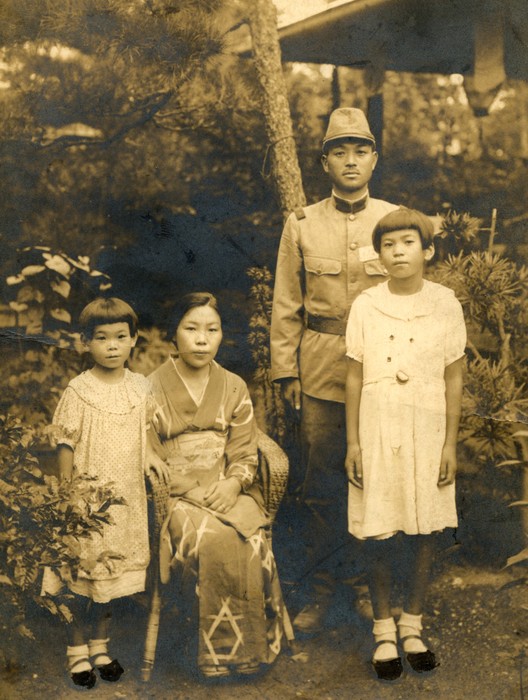
Mitsuko (at age 9 on right) & family
This harrowing first hand account of death and destruction was especially poignant as I traveled with my mother in Toyama and Takaoka
in October 2007. Here is her story...
Mitsuko's experiences during WW2
Mitsuko was the elder of 2 daughters from a fairly well-to-do family. Her father was a lawyer and a landowner, and
at times was also an officer in the Japanese army. He served in the war against China until he suffered a bayonet
wound through his shoulder, but later went on to fight in WW2. Mitsuko was 10 years old when her father fought in
China and 14 when the Japanese attacked Pearl Harbor, so her formative years were shaped by these wars. She was 18
at the end of WW2.
Getting into high school and college was very competitive since the workforce was needed for the war effort. Mitsuko
was fortunate to get into a good high school, but later her entire class (all females) was sent into forced labor
in a bolt factory in Toyama. They were housed in a nice hotel nearby. Since she had a cousin with some influence,
he was able to get her a job in the payroll department instead of the factory floor making bolts, like the rest of
her classmates. She handled the money, paying all the workers in cash on payday. She was confined to a small room with the cash and
had to ask for permission to leave to go to the bathroom. Besides being restrictive, the job was also very boring, so one day
she claimed to be sick and returned to her home. The Army soon came knocking on her door to force her back to work.
The complete destruction of Toyama
Boeing B-29 Superfortress
Fires raging in Toyama as seen from a B-29
Mitsuko was visiting a friend in Toyama on the night of the incendiary bombing of August 2, 1945. They lived on the outskirts of Toyama
near a rice paddy and she vividly remembers seeing the scores of B29s dropping their bombs on the city. The bombs lit up
the night sky, so she could clearly see the pilots and crew members in the planes as well as the string of bombs
falling from each plane. She spent the rest of the night in that rice paddy watching the city burn to the ground.
The next morning, it was clear the destruction of the city was complete, the US Air Force judging it to be 99.5%
destroyed. Many people tried to escape from the fires by jumping in the river, but the water was so hot they died
from the heat anyway. Mitsuko walked to her home in Takaoka, which was about 20 miles away. She saw what looked like
logs being pulled from the river and men with shovels throwing more logs into trucks. As she walked home, she
continued to see these "logs" on the road. She knew these were human bodies burned beyond recognition but put a wet
cloth over her nose and mouth to reduce the stench and told herself they were logs so she could make it home. She was
surprised that she did not feel a sense of fear during the bombing or even afterwards, instead she felt entirely numb
and disconnected from these horrific events. After she returned home, Mitsuko found out her parents had been
frantically searching for her all night, expecting the worse.
Mitsuko and Al Simpson Jr. meet in Toyama
Al Simpson - Takaoka Oct.'47
Alexander Hamilton Simpson Jr. was a sergeant in the US army and stationed in Japan from 1947 to 1952. He was one
of only 2 members of the US Military Government Team stationed in Toyama, there were also 6 officers in the CIC -
Counter Intelligence Corps. The other person in the US Military team was named Henley, who was 10 years older than
Al and released from prison so he could join the Army. He was in prison for murder. Both married local Japanese
women, as did their commanding officer. You can read the commanding officer's story here:
Military Occupation of Japan by Harry K. Fukuhara.
Several years later, I was born in Alabama and my father was not in town, but my parents agreed to name me after my father's two Army
buddies, Ralph W. Justice and Henley. The nurse did not understand my mother's accent and put on the birth certificate
"Henry" for my middle name, as it remains today. It's just as well that I am not named after a murderer.
Rebuilt Toyama Castle - Oct. 2007
The lifestyle Al and Mitsuko enjoyed was lavish by the standards of post-war Japan. Al worked in the Denki Building
(remember it was the only one standing) and the 8 officers and soldiers had housing constructed on the beautiful site
where the Toyama Castle once stood. The castle was originally built around 1543 by the lord of this region during the
shogun period of rule by samurai. Much of the castle was destroyed by fire in 1609 and rebuilt but was often damaged
by fire or earthquakes afterwards. The castle was home to the Toyama shogun until that system of rule was abolished
in 1867. After being destroyed in WW2, the castle was rebuilt in 1954 and has been used as a museum and park since
that time.
Since there were only 2 enlisted men in Toyama, they received the equivalent of officer quarters.
Mitsuko was even asked to go into town to select the furniture she wanted for her house. They all had their
own maid and Mitsuko was able to order all meals from a menu, even for visiting guests. She had a driver and jeep to
take her shopping, visiting friends and family, or to go to the beach. The driver would wait for her and take her home
when she was ready to return.
It took several years for the Army to approve the marriage, and their marriage certificate was finally signed and approved by General
MacArthur. Unfortunately, this marriage was never approved by Mitsuko's father.
Being the elder of 2 daughters, she was expected to carry on the Nishino family name. But Mitsuko not only married a US soldier who
her father fought against in the war, he knew this meant she would some day move to the US. So Mitsuko's father disinherited
her and would seldom speak to her again. Her father then arranged Mitsuko's younger sister's marriage with a family
friend who had twin boys. In Japanese tradition, the elder boy (by 5 minutes!) would inherit all the family wealth
and property so the younger boy was married off to Mitsuko's sister and he took on the Nishino name, inheriting the
Nishino family fortune. Their four children would have their college educations and first homes paid for by this family inheritance.
Al and Misuko lived in Toyama until the end of 1950 and then moved to Hiroshima, where Al was responsible for
training the Japanese soldiers. This was 5 years after the atomic bomb leveled that city and the long-term effects
of radiation exposure were not yet well-known. They were stationed there for about a year and a half, returning to
the US in the summer of 1952.
1953 in Ozark Alabama
Our house in Germany 1954-56 (picture taken 2007)
Al Simpson grew up in a poor family on a farm in Georgia, but tried to keep a similar lifestyle on returning to the US
as they enjoyed in Toyama. This was not easy to do on a sergeant's salary. By then they had a young daughter, Rita,
born in 1949 and me on the way. Mitsuko expected all Americans to be rich and have cooks, maids, gardeners, etc.
and was shocked to find that they could only afford one person to both cook and clean the house. A year and a half
later we all moved to post-war Germany, where US dollars would go a long way. We lived in a very nice home, had a
Mercedes and a boat on the lake.
By 1956 we returned to the US (Columbia South Carolina this time) and my mother finally had the realization that a
sergeant's pay does not allow for the luxury of servants and cooks and that not all Americans are rich.
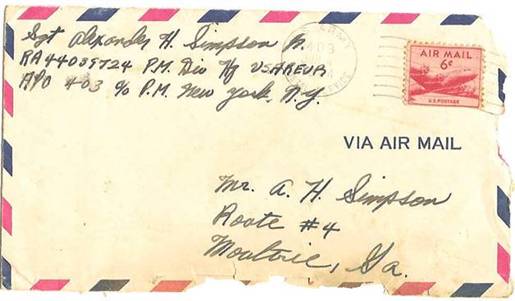
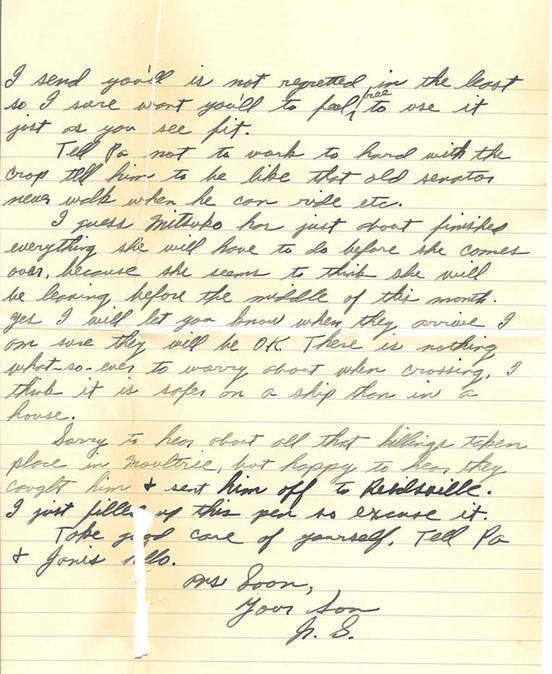
Letter from Al Jr. to his Mother when he was stationed in Germany.