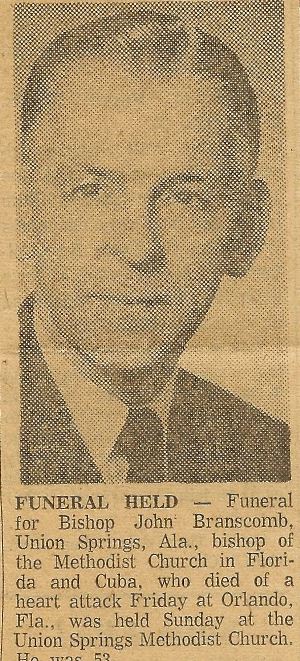
Bishop John Branscomb
Contributed by Eugenia Hobday
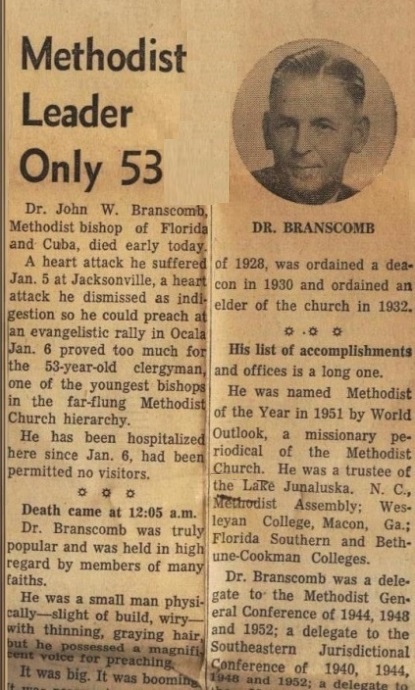
Anniston Star (Anniston, Ala.), May 17, 1954
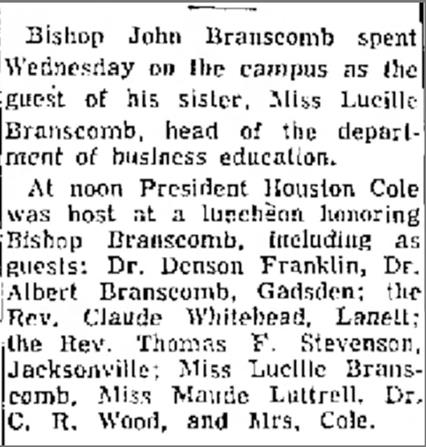
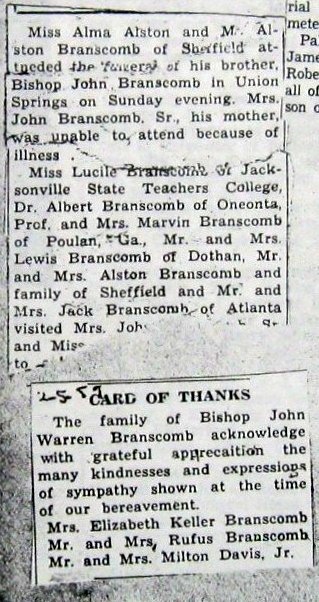
Contributed by Penny Leggett
Elizabeth Branscomb, widow of former Methodist bishop, dies
The Tampa Tribune - Wednesday, October 16, 1991
Elizabeth K. Branscomb, whose late husband was the former Bishop of the Florida Conference of the United Methodist Church,
died Tuesday. She was 84.
Branscomb was the widow of John W. Branscomb, who was bishop of the conference from 1952-1959.
John W. Branscomb served as senior minister at the First United Methodist Church in Tampa for about eight years during the 1940s.
Shortly after leaving Tampa, he moved to Orlando and became a bishop. The Tampa church named its fellowship hall after him.
For the past 16 years, Elizabeth Branscomb lived in Atlanta and was a member of the Druid Hills United Methodist Church. Her
survivors include a daughter, Betty Branscomb Davis of Tallahassee; son, John R. Branscomb of Decatur, Ga.; five grandchildren
and six great-grandchildren.
Branscomb bequeathed her body to Emory University School of Medicine.

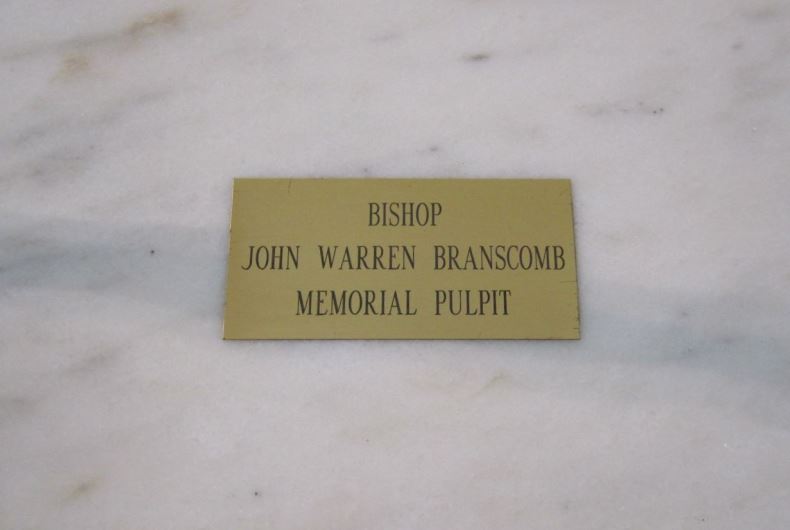
Memorial Pulpit - First United Methodist Church of Orlando, FL
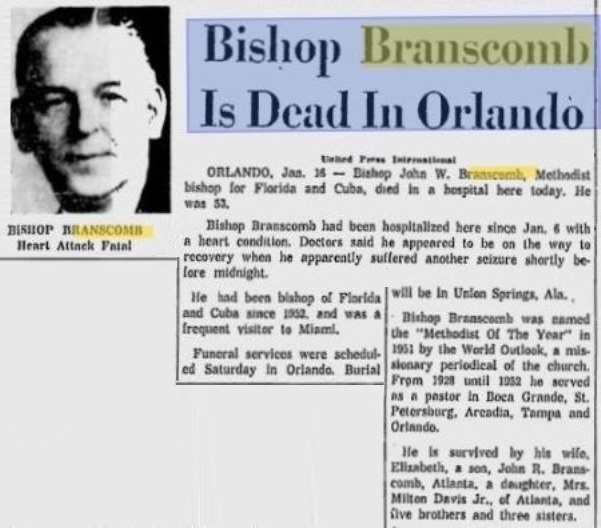
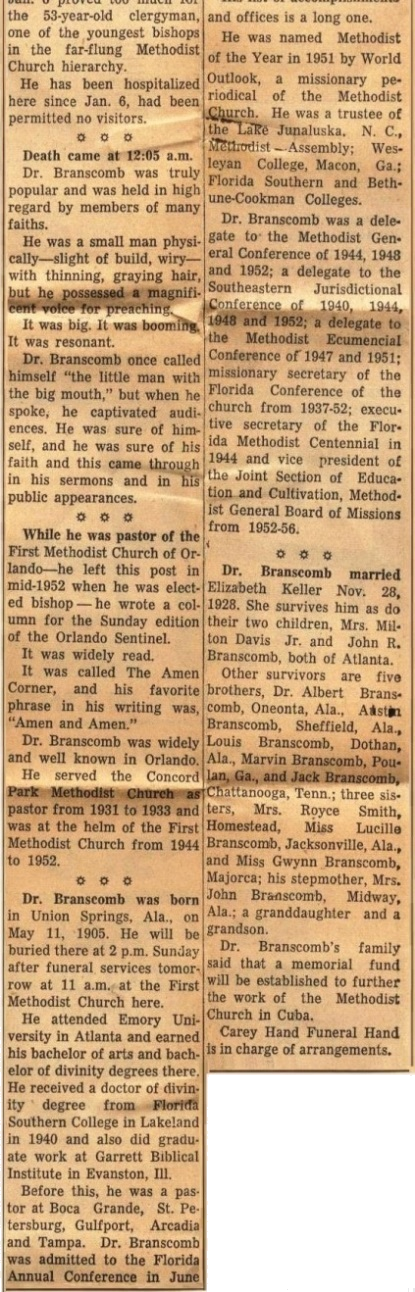
The Miami News - January 16. 1959
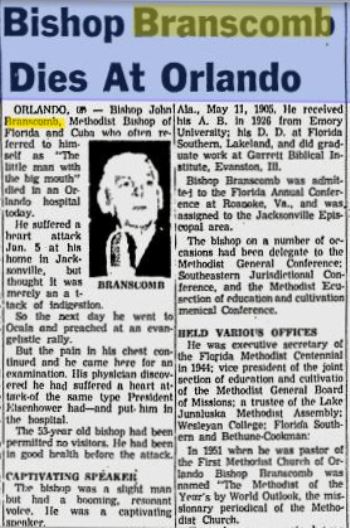
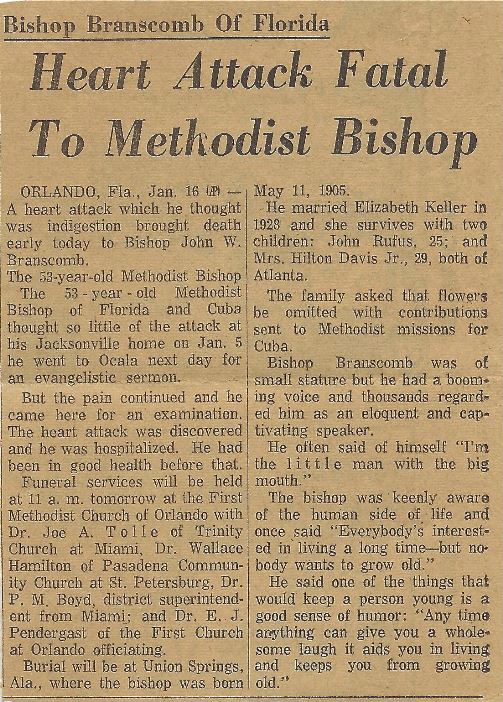
The Evening Independent - January 15, 1959
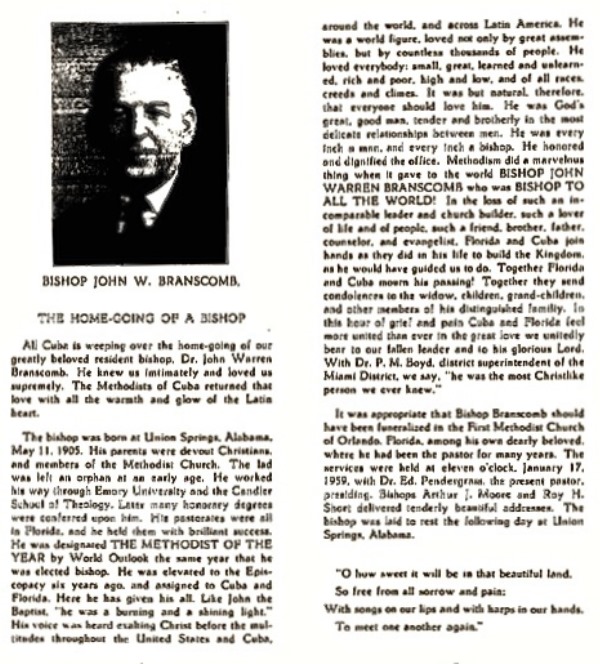
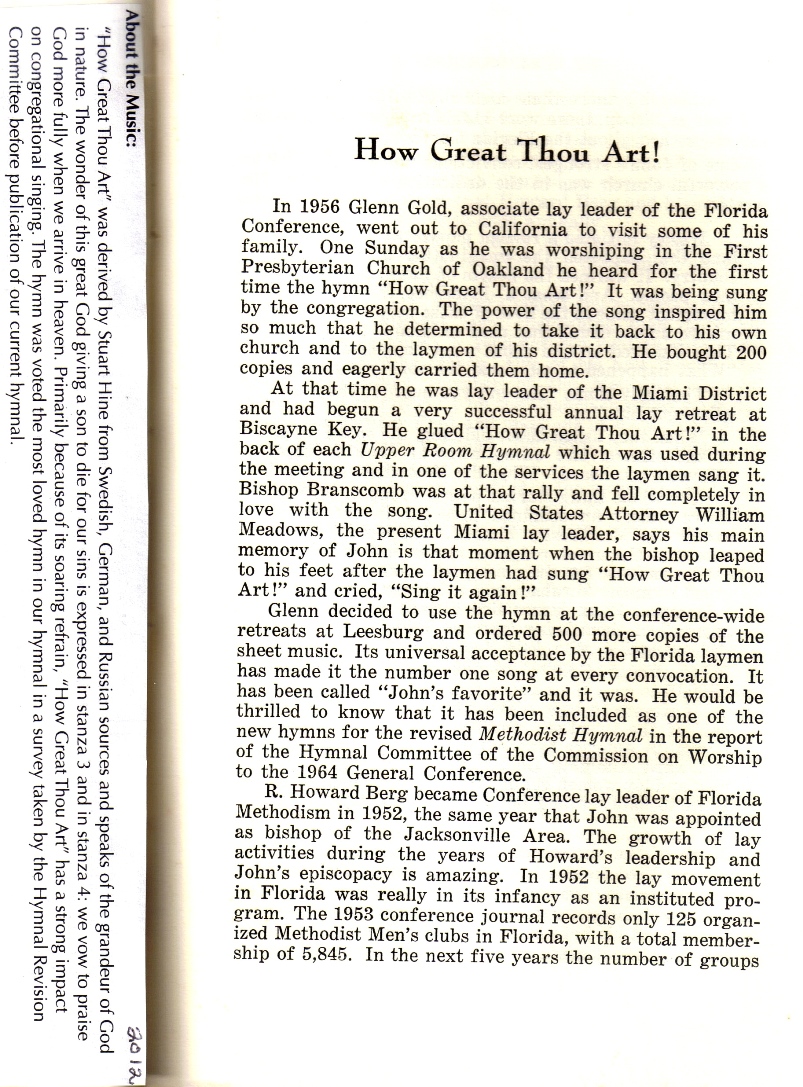
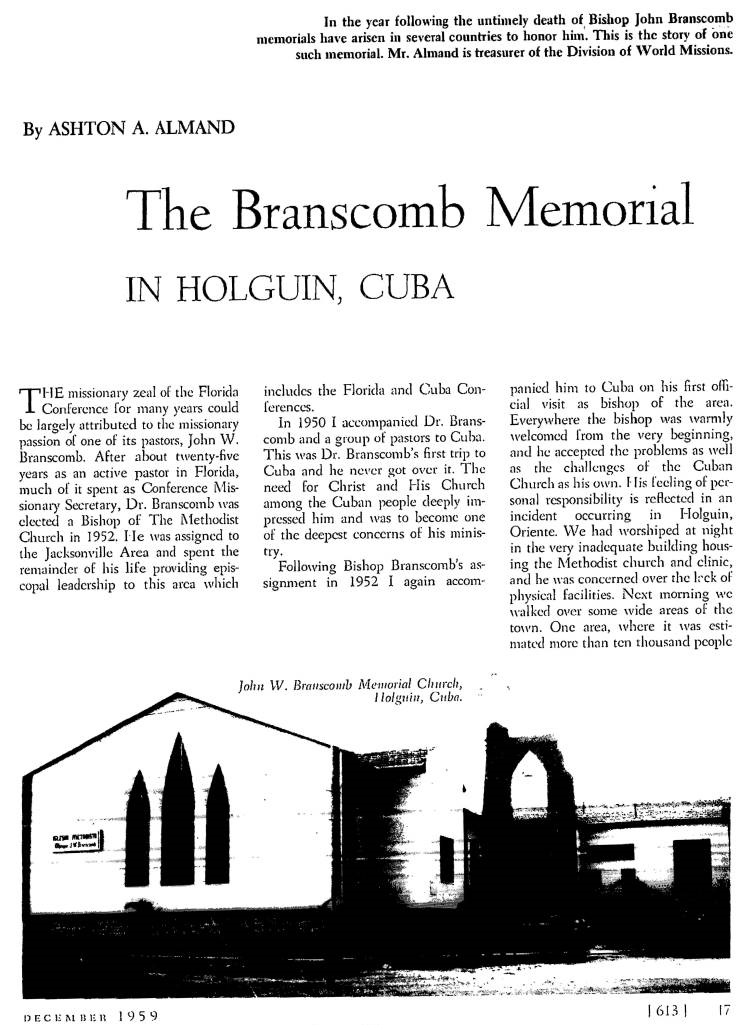
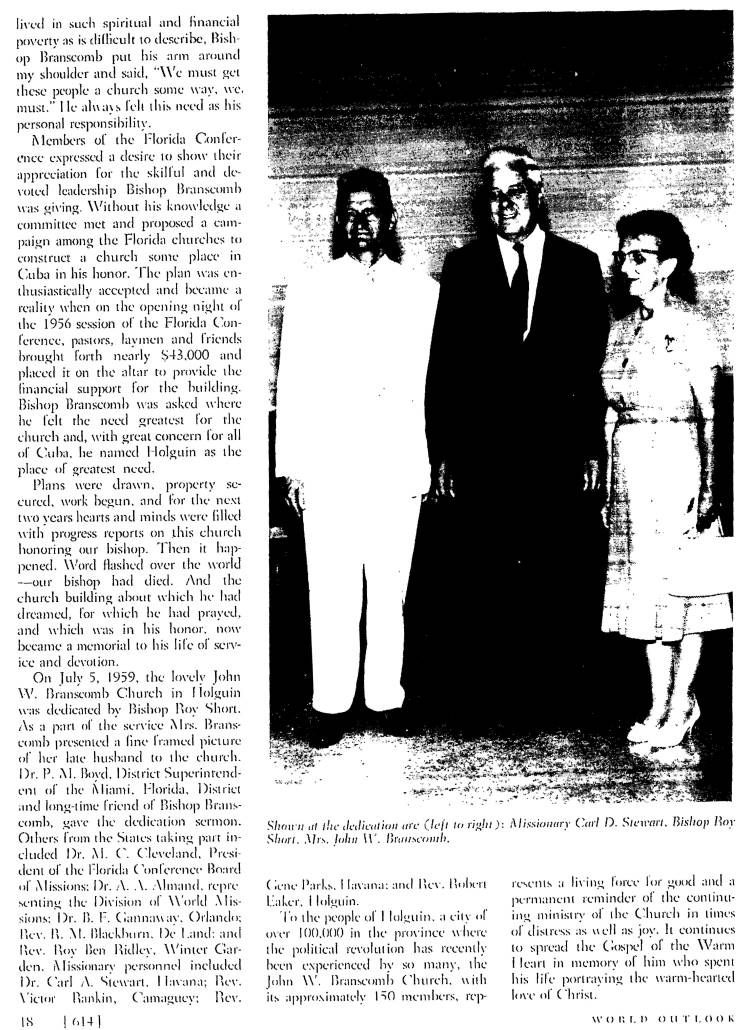
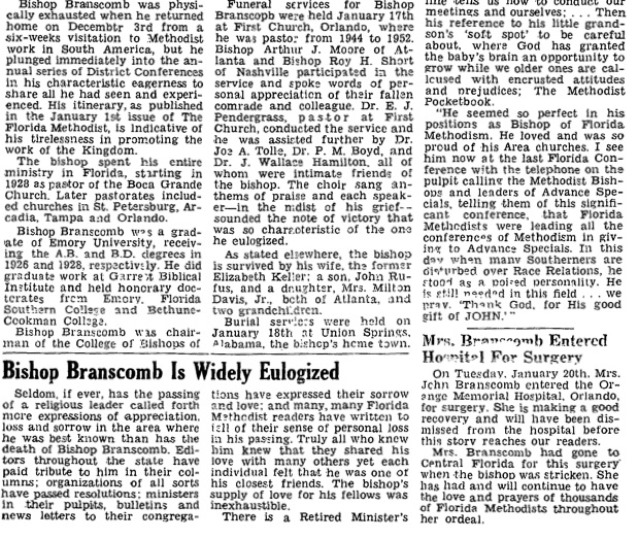


Branscomb Memorial Methodist, Holguin, Cuba 2015
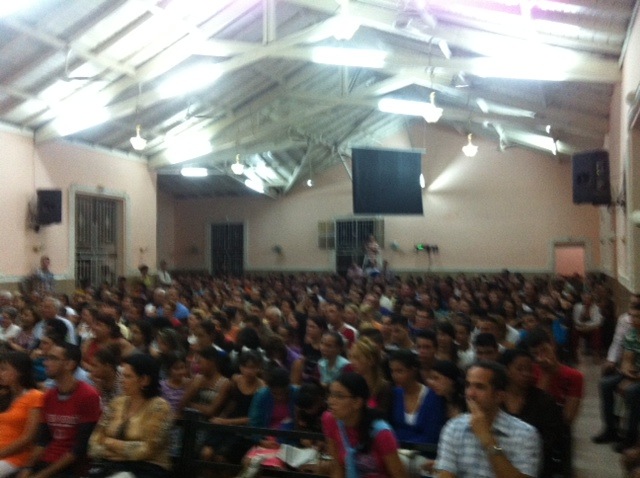
Branscomb Memorial Auditorium - Florida Southern College, Lakeland




John Warren Branscomb
Pages 53-61 from John Sanford Branscomb and His Family, 2003
by James Alston Branscomb and
Penelope Price "Penny" Leggett
Date and Place of Birth/Death
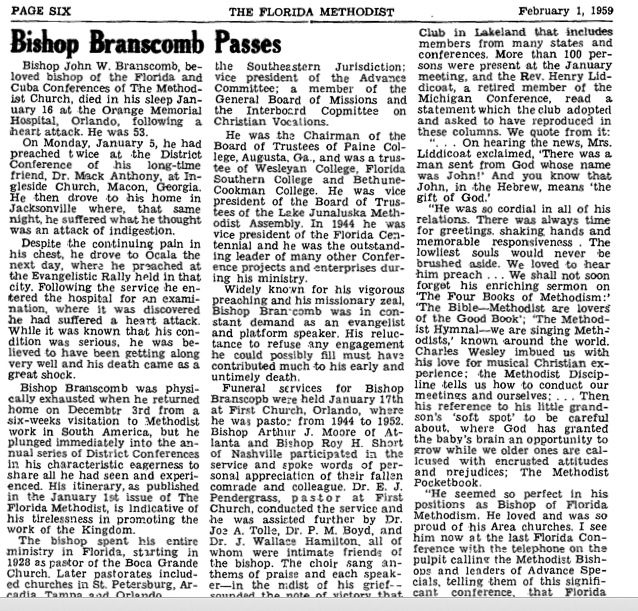
"John was born on an 'Alabama spring day,' a Thursday, May 11, 1905, in Union Springs, and died in his sleep only 53 short years later. After
returning from a six weeks visitation of Methodist work in South America, he suffered a heart attack on January 5, 1959, and died in the early
morning hours on Friday, January 16, 1959, at Orange Memorial Hospital, Orlando, Florida. Memorial celebrations were held at the First Methodist
Church Orlando, followed by additional services and burial in Union Springs. Both John and Elizabeth are buried in Oak Hill Cemetery, Bullock Co.,
Alabama. Their gravesites are with Uncle Albert and Aunt Mackie Branscombe.
Growing Up
"John's mother, Ida Dismukes Branscomb, died of pneumonia when he was only nine years of age and his father, John Sanford, passed away when he was
just twelve. For a young lad searching for motherly love, John adopted his dad's new bride in 1915. In a letter dated May 6, 1948, John wrote to
Eugenia Norwood Alston Branscomb: 'My dear Mother: ... As I observe Mothers' Day Sunday I'll be thinking of you and Marmee [Eugenia's mother, who
had died just nine days earlier]. Both of you have meant so much to all of us. Our relation has always been so sweet and satisfying.' John visited
'Mama' in Midway whenever he traveled to Union Springs.
"John grew up in Union Springs with the nickname 'Smut.' After the death of his father in 1917, Smut lived with his uncle, Ida's brother, Dr. Henry
Mosley Dismukes, on S. Prairie Street. He worked awhile for the "Bullock County Breeze" weekly newspaper in Union Springs, hoping he would get to go
work in Washington with one of his sisters. 'I have seen Uncle Bud and Uncle Dick and they have consented to let me go. I am going down to Midway and
see Mamma and I think she will let me go. ... I am sure I will be a good boy and will do all that you tell me to. ... With lots of love till I see
you, your little brother, Warren Branscomb.'
"His dad's younger brother, Uncle Dick, also was instrumental in providing parental guidance to a very independent youth. His Boy Scout Manual
indicated that at age 14 Smut was a member of Troop #1, Hawk Patrol, Height 4'11," Weight 93 lbs. Miss Flora McLeod, a school teacher, demonstrated
an interest in John when it was most urgently needed, which enabled him to make a success of life rather than continue with a disregard for discipline.
Following graduation from Union Springs High School, Miss Flora arranged a job for John in a marble quarry near Sylacauga. It was here on a September
night in 1923 that John heard a sermon that changed him and he 'fell completely in love with God and with life.'" (Recollections of John Rufus
Branscomb)
Education
"John worked his way through college and seminary in addition to obtaining scholarships where possible. Following his summer in Sylacauga he
attended Oglethorpe University, Atlanta, for one year before transferring to Emory University where he received a Bachelor of Philosophy (Ph.B.)
degree in 1926 and a Bachelor of Divinity (B.D.) degree from Candler School of Theology in 1928. An athlete, he was captain of the baseball team,
utility player in football, member of the 'E' club, and sports editor of the student newspaper, the 'Wheel.' He exercised leadership as president
of the Senior class; as a member of the Glee Club, the YMCA Inter-council, the French club, and Chi Sigma Chi; and as an active brother in Sigma
Alpha Epsilon (S.A.E.) Fraternity." (1952 Emory Alumnus and 1928 Emory Yearbook)
Oct. 1928, John wrote to update Brother Dawson of S.A.E. about his experiences since graduation: "After spending six years in the chapter there
I feel as close to S.A.E. as it is possible for a man to feel. ... know that my heart and soul is with the fraternity."
In 1930, John decided to continue his studies by attending the Methodist seminary Garrett Biblical Institute, Evanston, Ill., near Chicago. In later
years he received honorary degrees - a Doctor of Divinity, 1940, and Doctor of Laws, 1953, from Florida Southern College; LL.D 1953 from
Bethune-Cookman College, and a D.D., 1954 from Emory University, Georgia [He received the honorary. Doctor of Laws degree from Bethune-Cookman
College along with Mrs. Franklin D. (Eleanor) Roosevelt as recorded in the Daytona Beach "Sunday News-Journal," 1953.]
Career
John was a Methodist minister. A great preacher with an unusual presentation of faith, warmth and humor incorporated into his sermons. His true
calling, however, was that of a compassionate pastor. He loved people and ministered to their needs.
Chas. A. Thompson, editor of the "Florida Methodist" wrote: "My father was an honored but never a prominent member of the Florida Conference. After
his retirement, he and my mother made their home in Bradenton. Rather late one fall evening Mother was walking home from town. It was dark and, as
she stepped into the light from a street lamp at an intersection, she heard a passing car come to a hurried stop, saw a man get out of the car and
hurry across the street to her. It was Dr. Branscomb, then pastor of the First Methodist Church of Tampa, hurrying to fill a speaking engagement in
Sarasota. He had recognized her in the dim light and had stopped to speak to her and to inquire about my father's health. It was late, it was dark;
there was no reason in the world why a busy man should so delay his journey except that warm friendliness and genuine love for people that has always
characterized Bishop Branscomb."
"John was single and 23 years of age in 1928 when he went to his first church. 'I was given my first assignment on Gasparillo Island, just off
Florida's west coast, in a little town called Boca Grande. The name of the town meant big mouth.'" (We Remember John by Richard E. Blanchard)
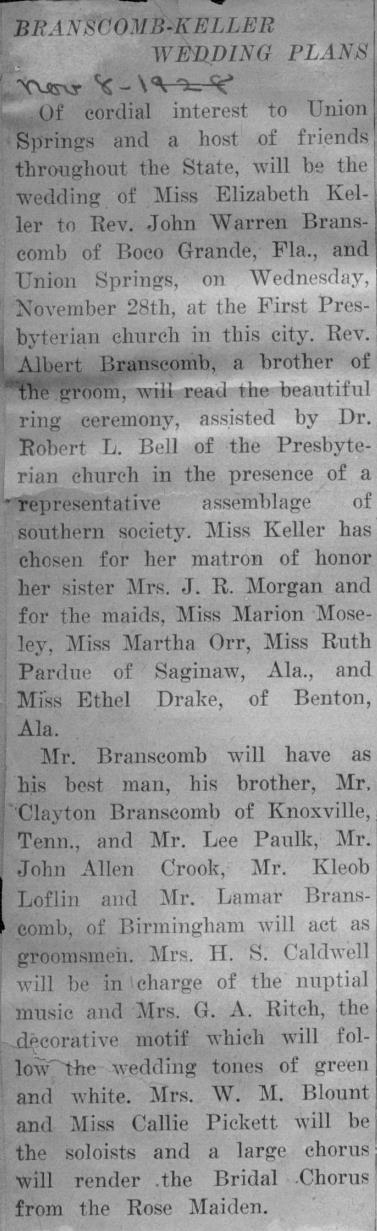
Just several months after beginning his first pastoral assignment, John returned to Union Springs to marry Elizabeth Keller on November 28, 1928.
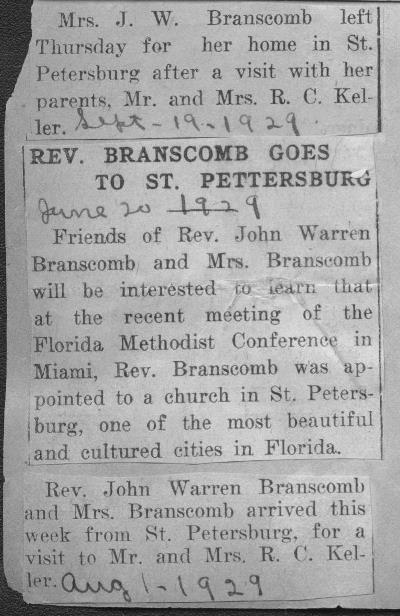
The next year, 1929, John was appointed to Gulfport-Childs Park Charge, a parish of 217 members located on the outskirts of St. Petersburg. Betty
joined the family in St. Pete, on November 28, 1929. Several months later, John decided to enhance his preaching skills and continue his studies by
attending Garrett. Upon his return to Florida in 1932 he requested an appointment and was sent to Concord Park Methodist Church in Orlando. Rufus
was born here on September 10, 1933, and was with the family when they moved to Trinity Methodist Church, Arcadia, Florida. After three years John
was appointed pastor of historic First Methodist, Tampa, where he served until his move to First Methodist Orlando in 1944." (Who Was Who In America
1951-1960)
At the 1948 Jurisdictional Conference, John Branscomb withdrew to break a deadlock and thus made possible the election of Bishop Roy H. Short. "There
were many then who felt that he would surely be the favorite candidate for that high office" when the next conference should convene. "That that
feeling had grown became evident with the casting of the very first ballot at Roanoke." ("The Florida Methodist: The Official Conference Paper,"
Aug. 1, 1952)
At the Southeastern Jurisdictional Conference of the Methodist Church held in Roanoke, Virginia, on June 27, 1952, at 9:30 p.m., after leading on
every ballot, John was elected Bishop on the 15th ballot with 267 of the 328 votes cast. John became the first bishop elected from the Florida
Conference. For the first time, a freshman bishop was assigned to his own Conference, and John returned to Florida to serve his fellow Methodists
there and in Cuba. "At 47 he becomes next to the youngest of the 70 bishops of the church.
"He came to Orlando in 1944 from First Methodist, Tampa, and soon distinguished himself as a civic leader as well as a dominant figure in religious
circles. He had served as president of the Kiwanis Club in Tampa and was elected Vice-President of the Orlando Executives Club. He is immediate past
president of the Orange County Ministerial Assoc. and has been an active worker in various secular organizations in the community and throughout the
state.
"In receiving the assignment as resident and presiding bishop of the Jacksonville area, which includes Cuba, conclusive proof of Bishop Branscomb's
popularity among his co-workers was demonstrated." (Orlando newspaper article)
As an Emory alumnus, he was "a vigorous worker in behalf of the University. He has served as vice-president of the national Alumni Assoc., as
councilman for the Class of 1928-Theology, as president of the Emory Club of the Florida Conf. and as an energetic participant in activities of
various local Florida Alumni clubs. It was he who, back in 1931, originated the idea of the loan fund whereby the Florida Conference Club until
today helps young men from that state attend Emory's School of Theology." ("Emory Alumnus, 1952")
"The Daily Christian Advocate, Southeastern Jurisdictional Conference 1952" stated John was conference missionary secretary since 1937; Delegate
to General Conference 1944, 1948, 1952 Delegate to Southeastern Jurisdictional Conference 1940, 1944, 1948, 1952; Delegate to Ecumenical Conference
in Springfield, Mass., 1947; Delegate to Ecumenical Conference in Oxford, England, 1951; Executive secretary, Florida Methodist Centennial, 1944;
Youth Camp Campaign, 1947; Member Board of Trustees, Lake Junaluska Assembly, N.C. ; Wesleyan College, Macon, Georgia; Florida Southern College,
Lakeland; Bethune-Cookman College, Daytona Beach."
He received the first annual "Methodist of the Year" award from "World Outlook," pictorial Methodist missionary journal, in June 1952. The award
would be awarded to "a pastor whose consistent support of the missionary program, development of the missionary spirit and promotion of the missionary
periodical of the Church are outstanding." These achievements were credited to John while he was at First Methodist, Orlando: "During the calendar
year of 1951 First Church, Orlando, sent in $11,749.04 for Advance Missions Specials, an amount of extra giving which reflects exceptionally effective
missionary cultivation. This church is supporting three missionary families and several native workers, giving annually to missions no less that
$35,000 of a total church budget of $65,523, or more than half. Every department and every organized group in the church has a mission special."
Half the price of every "World Outlook" membership was paid and it was promoted through moveable bulletin boards. Special offerings were taken to
support Mission Specials. John was "president of the Southeastern Jurisdiction Board of Missions. He has also done an outstanding job as Executive
Secretary of the Florida Conference Board of Missions. Last year every charge in that Conference had at least one mission special. Dr. Branscomb
has aided in developing the strong district missionary program of the Conference. ... Mission experts are called in to speak at District Institutes.
In addition to his denominational leadership Dr. Branscomb has helped to promote an interdenominational Florida Chain of Missionary Assemblies held
annually in 22 cities." ... "Congratulations to Dr. John Branscomb, 'Methodist of the Year.' May his tribe increase, and may his whole-hearted service
to the cause of missions inspire others to greater achievement." (Probably from "World Outlook")
Shortly after he left Orlando First Methodist, "Christian Century" magazine picked it as one of the 10 "great churches" of the country.
Memorials include The Bishop John Warren Branscomb Memorial Pulpit, First Methodist Church, Orlando; Branscomb Memorial Auditorium, Florida
Southern College, Lakeland [a bas-relief portrait plaque of the late bishop bears the inscription, "My God - How Great Thou Art," from a favorite
hymn of John's]; the Youth and Fellowship Building of First United Methodist Church, Tampa; the Bishop J. W. Branscomb Administration Building plus
a pew in the Assembly Hall at Lake Junaluska, North Carolina; and the Branscomb Chair of Religion at Florida Southern to provide an outstanding
educator for pre-ministerial students and others planning careers in church work.
Marriage - to Whom and Date
John married Elizabeth Keller (b: 12/12/1906 in Union Springs, Bullock Co., Alabama; d: 10/15/1991 in Atlanta, Fulton Co., Ga.) on
November 28, 1928. During a rousing reception and shower upon their return to Boca Grande, "a 13 year old boy looked at the petite, 85 pound
Elizabeth, and averred, 'Why, she's not big enough to do anything.'" She was the one, however, "who understood him better than any of us and
who loved him best of all." (We Remember John)
Children
Betty Joan Branscomb (b: 11/28/1929)
John Rufus Branscomb (b: 9/10/1933)
"John married both Betty and Rufus, and baptized his first two grandchildren. He never had the opportunity to meet and greet his other grandchildren.
But someday, when they enter the gates of heaven, he will be there to welcome them with a smile, a hug and a resounding ... Amen and Amen."
(Recollections of John Rufus Branscomb)
Characteristics/lnterests and Participation in Religious and Civic Organizations
"Bishop Henley said, 'There are memorial churches in Cuba ([J. W. Branscomb Methodist Church] Holguin, Cuba and many other areas) and Brazil
(Pilar) bearing Bishop Branscomb's name, in which people learned about the Christ John loved so well.' ... The Branscomb Chair of Religion at
Florida Southern College is sponsored by the Orlando District of the Methodist Church as a tribute to John's interest in higher education and
the spiritual recruitment of youth for the Kingdom of God. John's funeral at the First Methodist Church of Orlando was repeated in the First
Methodist Church in Union Springs for the benefit of relatives, childhood neighbors and friends there. A life-size portrait of John is mounted
in the narthex of the First United Methodist Church of Orlando. ... After John's death, the Branscomb Memorial Committee was appointed to ascertain
what would be the finest tribute which Florida Methodism could make in honor of him. The result is the Branscomb Memorial Auditorium on the campus
of Florida Southern College in Lakeland, Florida, the permanent site for the Florida Annual Methodist Conference." ("The History of the Branscombs
of Union Springs, Alabama, and Some of their Participations in the Methodist Church," by John's brother, Alston)
"Mrs. Branscomb was not present at the time of the bishop's election but friends in Orlando chartered a plane and flew her to the scene of the
Conference when the news of the election reached that city."
When John arrived home at the airport, he was greeted by hundreds of friends and neighbors." ("The Florida Methodist 1952") "As long as I live I
will remember that expression. We blended our voices in singing 'Praise God from Whom All Blessings Flow' and then formed a parade of automobiles. ...
There was no horn-blowing, no noise, just good neighbors doing something for a fellow which warmed his heart way down deep where love and faith and
gratitude abide." ("Amen and Amen" column)
"Back home in Orlando, the election of Bishop Branscomb was real news and the source of much gratification. The local papers and radio stations
announced the news with pride and satisfaction and the 'Orlando Morning Sentinel,' for which he had long done a Sunday feature known as 'The Amen
Corner,' honored him editorially." (“The Florida Methodist, August 1, 1952")
"There was no surprise in his home base of evangelical operations when the news was spread that Dr. John W. Branscomb, pastor of Orlando's First
Methodist Church, had been elected a bishop. Central Floridians of all faiths, as well as Methodists throughout the Southeast, knew some day the
church's Jurisdictional Conference for seven states would elevate him to the high office he richly deserves, even though bishops usually are more
than 47 years old. ... Eloquent orator, humble pastor, compassionate adviser, foe of civic evils and friend of civic needs, warm comforter of those
in distress, joyful leader of any worthwhile project to benefit his neighbor and mankind in general, Dr. Branscomb will spread his Amen and Amen over
a much wider field in his new role. … But those who know him best realize that honors and title are not his goal in life. Come what may, John
Branscomb is simply a floor-manager for Christianity, and he'll stay just that. If the title of bishop puts him into a better position to be a
floor-manager, Methodist-style, well - Amen and Amen!" (editorial)
"A man of short stature, Bishop Branscomb had a booming voice and a delivery that kept him in demand as a preacher and speaker. He was a tremendous
storyteller and spiced both his sermons and his lectures with anecdotes. He was regarded as an eloquent and captivating speaker. ... His story telling
sprang from a personal sense of humor, a faculty which he constantly tried to cultivate in his colleagues and everyone he met."
("Union Springs Herald" obituary)
'''What makes a name significant?' asked Dr. John Branscomb in his column, 'The Amen Corner,' on Oct. 31, 1948. And Dr. Branscomb answered, 'It's the
character behind it, the life poured into it.' Dr. Branscomb died yesterday, but that fragment of a 10-year-old column was a key to his life." The
obituary mentioned that even though he had been away from Orlando six years, he was never forgotten. "Occasionally he would return here and would
preach at the First Methodist. He packed them in every time. He was a spellbinding and magnificent speaker with a silver tongue. ... The Western
Union office here was swamped with messages of condolence to his family. Associated Press and United Press International moved quickly to transmit
the news of his death through the state." (Orlando obituary)
"Methodist bishops, church officials and laymen from as far away as Nashville, Tennessee, and Camaguey, Cuba, together with hundreds of friends
jammed Orlando's First Methodist Church yesterday to pay their final respects to Dr. Branscomb. ... In the overflow audience at the services yesterday
were three bishops and the representative of a fourth, the presidents of Florida Southern College, Paine College, Augusta, Georgia; and Bethune-Cookman
College, Daytona Beach; Methodist ministers from throughout the state, the 10 district superintendents, leading Orlando businessmen and hundreds of
others who knew and loved the personable Dr. Branscomb."
Dr. E. J. Pendergrass, present pastor of the church, spoke of the regard in which John was held by people of all faiths who knew him.
Dr. P. M. Boyd "marveled at the bishop's capacity to love others and inspire affection in them. 'He was the most gracious, friendliest, most
charitable, most brotherly person I have ever known.'
'''This man,' Dr. [J. Wallace] Hamilton said, 'was the most lovable, friendly, gifted, exciting personality that has ever touched my life. ... Perhaps
no living man had as many friends as John had.”
Bishop Arthur J. Moore, Atlanta, senior bishop of the Methodist Church, declared: "The Lord did a beautiful thing for the world when He gave us
John." "He quoted the words of Jesus, 'Today thou shall be with Me in Paradise,' and stated ... I cannot believe God would give him only 52 [sic]
years and make an end of it,' Bishop Moore said. 'God has set him to work in a wider ministry,' and he concluded leaning over the coffin, 'Goodbye,
John. God bless you.’” ("Clergymen Pay Tribute to Bishop," newspaper article)
