2013 AAAS Philip Hauge Abelson Prize Presented to Lewis M. Branscomb
Contributed by Margaret Cothran
This article is copied with permission from the American Association for the Advancement of Science (AAAS)
American Association for the Advancement of Science (AAAS) website
Lewis M. Branscomb, a prominent American physicist, policy advisor and research manager, has been chosen by the American Association
for the Advancement of Science (AAAS) to receive the 2013 Philip Hauge Abelson Prize.
He was honored "for his prolific and distinguished career in science, technology, innovation, and policy" and "for his achievements
in academia, in business, in government, and as a philanthropist."
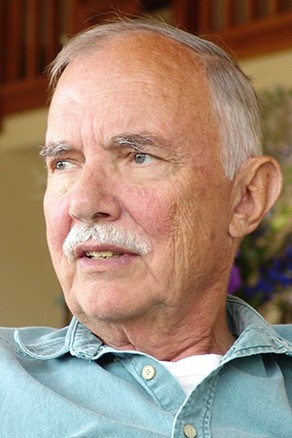
Lewis M. Branscomb
courtesy of Constance M. Branscomb
|
Branscomb is Aetna Professor in Public Policy and Corporate Management (emeritus) at Harvard University and also holds appointments
at the University of California, San Diego in the School of International Relations and Pacific Studies and the Scripps Institution
for Oceanography. He has authored or co-authored more than 500 papers and ten books on topics ranging from basic physics and
astrophysics to innovation and entrepreneurship, domestic and international science policy, information technology, and the
science of countering terrorism.
In nominating Branscomb for the award, James J. McCarthy, professor of biological oceanography at Harvard University, said:
"When one thinks of unrelenting advocacy for making sound science the basis of decision making, Lewis Branscomb is one of the
first names to come to mind. His career is a metaphor for effectiveness at the interface of science and policy." He added,
"Legions of public leaders, peers and former students are more effective today in their uses and pursuit of science for the
public good because of Lewis Branscomb's lifelong contributions."
In addition to his outstanding scientific and technical achievements, Branscomb has taken on a wide range of public service
roles. President Jimmy Carter appointed him to the National Science Board and he served as chairman of that board from 1980
to 1984. He served on the President's Science Advisory Committee (1964-1968) under President Lyndon Johnson, and was appointed
to the National Productivity Advisory Committee by President Ronald Reagan.
Branscomb also has served on numerous boards in both the corporate and public sectors, including as president of the American
Physical Society and Sigma Xi and on the AAAS Board of Directors. He is a member of the National Academy of Sciences, the
National Academy of Engineering, the Institute of Medicine, and the National Academy of Public Administration. He also is
a fellow of AAAS.
In 2012, Branscomb helped launch the Center for Science and Democracy at the nonprofit Union of Concerned Scientists, with a
goal of "strengthening American democracy by advancing the essential role of science, evidence-based decision making, and
constructive debate" in public policy making.
The Abelson Prize was inspired by the late Philip Hauge Abelson, long-time senior advisor to AAAS and editor of the journal
Science. Abelson, who also served as president of the Carnegie Institution of Washington, died 1 August 2004, following more
than 60 years of service to science and society. The award is given annually to either a public servant, in recognition of
sustained exceptional contributions to advancing science, or to a scientist whose career has been distinguished both for
scientific achievement and for other notable services to the scientific community. Established in 1985 by the AAAS Board
of Directors, the award consists of a commemorative medallion and an honorarium of $5,000.
Branscomb received his B.A. in physics summa cum laude from Duke University in 1945 and his Ph.D. in physics from Harvard
in 1949, where he was also appointed Junior Fellow in the Harvard Society of Fellows. In his early research, he pioneered
the study of atomic and molecular negative ions and their role in the atmospheres of Earth and stars. In 1951, he joined
the National Bureau of Standards (NBS) as a research physicist, and was a co-founder of the Joint Institute for Laboratory
Astrophysics at the University of Colorado. In 1969, he was appointed director of NBS (now the National Institute of Standards
and Technology) by President Richard Nixon. He also has served as vice president and chief scientist at IBM and was editor of
Reviews of Modern Physics.
Branscomb's honors include the Vannevar Bush Award of the National Science Board, the Arthur Bueche Award of the National
Academy of Engineering, the Gold Medal of the U.S. Department of Commerce, the Okawa Prize for Communications and Informatics,
and the Centennial Medal of the Harvard University Faculty of Arts and Sciences.
The Abelson Prize will be bestowed upon Branscomb during the 180th AAAS Annual Meeting in Chicago, Ill., 13-17 February 2014.
A ceremony and reception will be held in the Rouge Room of the Fairmont Chicago Hotel on Friday, 14 February at 6:15 p.m.
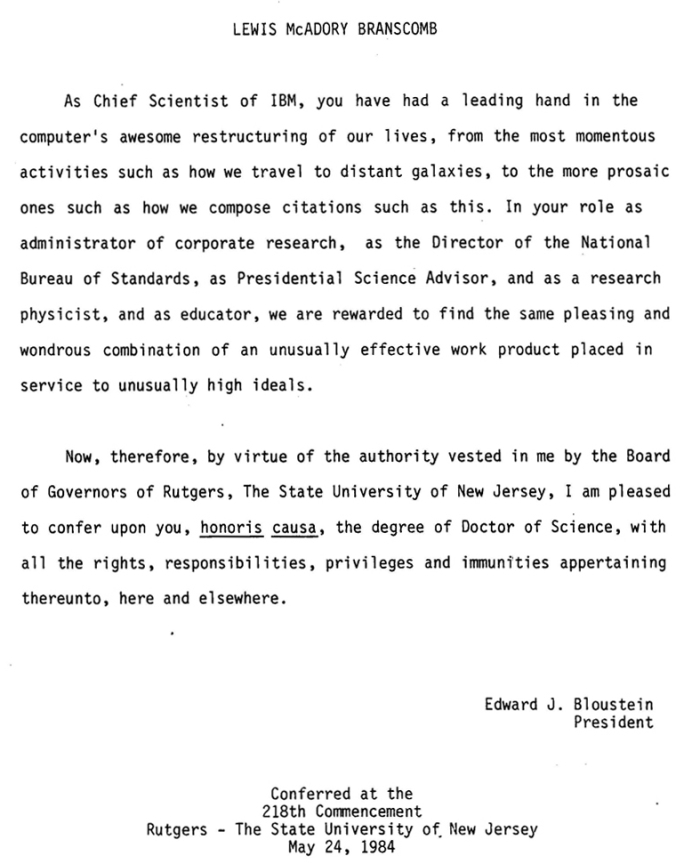
Honorary Doctorate awarded to Lewis Branscomb
by Rutgers University
Contributed by Penny Leggett
Lewis M. Branscomb - Professional Biography
Lewis M. Branscomb is Aetna Professor of Public Policy and Corporate
Management (emeritus) in Harvard University's John F. Kennedy School of
Government. Until July 1996, he directed the school's Science, Technology,
and Public Policy Program in the Belfer Center for Science and International Affairs. He
currently holds two appointments at the University of California at San Diego,
Adjunct Professor in the School for International
Relations and Pacific Studies (IRPS) and Research Associate in the Scripps Institution of Oceanography (SIO). His
current research focuses on domestic and international research and innovation
policy, information infrastructure, policies to make the world safer and more
secure from disasters, and on the management of science and technology in the
furtherance of democratic governance, economic equity and safety and security.
Dr. Branscomb was graduated BA in physics from Duke University summa cum
laude in 1945. He served as a junior officer in the US Naval Reserve in
the Philippines during World War II. He received his PhD in physics from Harvard
in 1949, when he was appointed Junior Fellow in the Harvard Society of Fellows.
A research physicist at the U.S. National Bureau of Standards (NBS, now the
National Institute for Standards and Technology)
from 1951 to 1972, he, with Stephen J. Smith, founded the crossed-beam study of
structure and spectra of atomic and molecular negative ions, and applied this
knowledge to chemical aeronomy, stellar atmospheres and ionized hypersonic
wakes. He served as Editor of the Reviews of Modern Physics from
1963-1969 and was President of the American Physical Society in 1979.
He was the first Chairman of the Joint Institute for Laboratory Astrophysics
(JILA) in Boulder, CO. He was appointed Director of NBS by President Nixon in
1969. In 1972 he was named vice president and chief scientist of IBM Corporation
and later a member of the IBM Corporate Management Board. In 1980 President
Carter appointed him to the National Science Board and in 1980 he was elected
chairman serving until May 1984.
Branscomb was appointed by President Johnson to the President's Science
Advisory Committee (1964-1968) and by President Reagan to the National
Productivity Advisory Committee. He is a member of the National Academy of
Engineering, the National Academy of Sciences, the Institute of Medicine and the
National Academy of Public Administration. He served on the Technology
Assessment Advisory Committee to the Technology Assessment Board of the United
States Congress, and in 1991 was appointed to the Massachusetts Governor's
Council on Economic Growth and Technology.
He holds honorary doctorates from fifteen universities. He has served as a
director of four corporations (Mobil, General Foods, MITRE, and Draper
Laboratories) still serves as a director of Lord Corporation in Cary, NC. For a
continuous period of 57 years he and/or his father B. Harvie Branscomb served as
trustees of Vanderbilt University. He has been a trustee of Woods Hole
Oceanographic Institution, and the National Geographic Society. From 1984 to
1986 was an Overseer of Harvard University. In December, 1998, he was awarded
the Okawa Prize "for outstanding contributions to the progress of informatics,
scientific and technological policy and corporate management."
Prof. Branscomb has written extensively on information technology,
comparative science and technology policy, and management of technology. His
books are:
- Confessions of a Technophile (1994), Beyond Spinoff: Military and
Commercial Technologies in a Changing World, (with J. Alic, et.al., 1992)
- Empowering Technology: Implementing a U.S. Policy (1993),
- Converging Infrastructures: Intelligent Transportation and the National
Information Infrastructure (with James Keller, 1996),
- Informed Legislatures: Coping with Science in a Democracy (with Megan Jones and David Guston, 1996),
- Korea at the Turning Point: Innovation-Based Strategies for
Development (with H.Y. Choi, 1996),
- Investing in Innovation: Creating a Research and Innovation Policy that
Works (with James Keller, eds., 1998),
- Industrializing Knowledge: University-Industry Linkages in Japan and the
United States (with Fumio Kodama and Richard Florida, eds., 1999),
- Taking Technical Risks: How Innovators, Executives, and Investors Manage
High-Tech Risks (with Philip E. Auerswald, 2001),
- Making the Nation Safer: The Role of Science and Technology in
Countering Terrorism (co-chaired with Richard Klausner, Committee on
S&T for Countering Terrorism, National Academies, 2002), and
- Seeds of Disaster, Roots of Response: How Private Action can Reduce
Public Vulnerability (with P. Auerswald, Todd M. LaPorte, and E.
Michel-Kerjan, Cambridge University Press, September 2006).
His late wife, Anne Wells Branscomb, a legal scholar
in the field of computer networks and information technology, was the author of
- Who Owns Information?,
- Emerging Law for the Electronic Frontier,
- My Own Sense of Place: A Southern View with a Northern Exposure,
- Toward A Law of Global Communications Networks.
They have a son, Harvie H. Branscomb of El Jebel, CO, a daughter Katharine C.
Branscomb Kelley of Woodside, California, and a granddaughter Clara Louise
Kelley.
Anne Wells Branscomb - Biography
Margaret Anne Wells was born in Statesboro, Georgia on November 22, 1928,
daughter of Guy Herbert Wells and Ruby Hammond Wells. She grew up in the 1835
Mansion of the ante-bellum Governors of Georgia. The Mansion, as this elegant
structure is known, served as the residence of the President of the Georgia
State College for Women (now known as Georgia College & State University.
Guy Wells was a much beloved educator and, perhaps more important, was for all
his life an ardent opponent of racial segregation and bigotry.
Anne graduated from GSCW, and then studied at the University of North
Carolina at Chapel Hill, where she earned a second baccalaureate degree. She
earned a Masters Degree from in Government from Harvard University. Having won a
Rotary International Fellowship in 1950, she went to the London School of
Economics to work on a doctoral dissertation on political education in the
British Labor and Conservative Parties.
On her return to the US, she married (October 13, 1951) Lewis M. Branscomb,
whom she met while she was a graduate student at Harvard and Lewis was a Junior
Fellow in Harvard's Society of Fellows.
As Chairman of the Communications Law Division of the American Bar
Association Science and Technology Section from 1980 to 1984, she organized a
number of research and professional educational projects, the most prominent of
which produced a book, Toward a Law of Global Communications Networks,
which she edited. In 1983 she was instrumental in bringing lawyers into a legal
forum organized by the International Telecommunication Union and served as
Chairman of the Program Advisory Group for the Telecom '87 Legal Symposium.
She has held academic appointments as Adjunct Professor of International Law
at the Fletcher School of Law and Diplomacy and as Professor of
Telecommunications Law and Public Policy at the Polytechnic University. During
the summer of 1995 she was a member of the faculty of the Salzburg Seminar's
series on International Intellectual Property Rights. Mrs. Branscomb served as a
trustee of the Rensselaer Polytechnic Institute (the first woman on that board,
thanks to Bob O. Evans). She also served on the Boards of National Public Radio
and Educom, and was an ABA appointee to the National Conference of Lawyers and
Scientists. She also served as a trustee of the Pacific Telecommunications
Council.
As a member of the United States Department of Commerce Technical Advisory
Board (CTAB), she chaired a working group on developing human resources which
produced, in 1980, a report entitled "Learning Environments for Innovation." She
has served as a member of the Commission on Freedom and Equality of Access to
Information, as consultant to the National Science Foundation, the Office of
Technology Assessment of the U.S. Congress, the Department of State, the Rand
Corporation, the Carnegie Corporation, the Aspen Institute, the World Bank, and
other corporate and non profit organizations. She lectured to groups worldwide
including: Japan, Singapore, Finland, Austria, New Zealand, Canada, Israel and
the People's Republic of China.
During the 1994-95 academic year she was a Scholar-in-Residence in the
Annenberg Public Policy Center of the University of Pennsylvania, where she
delivered the Annual Leonore and Walter Annenberg lecture entitled "Roadblocks
to the Global Infobahn." In 1985 she was one of three inaugural fellows of the
Freedom Forum Media Studies Center at Columbia University, in 1983-84 a Visiting
Scholar at the Yale University Law School, in 1972 a member of the core group
organizing the first sessions of the Aspen Institute Communications and Society
program.
Mrs. Branscomb was an honor graduate of the George Washington University Law
School, held a M.A. in political science from Harvard University, B.A.'s from
the University of North Carolina and Georgia College, an LL.D. (Hon.) from Notre
Dame, and studied international relations at the London School of Economics as a
Rotary Foundation Fellow. She was a member of Phi Beta Kappa and the Order of
the Coif.
