Contributed by Francine Rossman
More About ANNA LOUISE SIMPSON:
Burial: Unknown, Mt Carmel Meth, Gwinnett Co., GA
Education 1: 1910, State Normal School (Univ of GA) - bachelor's degree
Education 2: Columbia University - master's degree
Occupation: Teacher for 35 years in Atlanta and Gwinnett Co.
Property: 1971, Donated 239 acres to Methodist church - Simpsonwood Conference Center in Norcross
Will: 1975, Gwinnett Co., GA105


The History of Simpsonwood Conference and Retreat Center
DEDICATION
This history is dedicated to Julia O'Neil and James Paine.
Although both were major players in the making of Simpsonwood, their names appear
seldom, if ever, in this history because they were its authors. To them go our sincere and abiding gratitude.
THE HISTORY OF SIMPSONWOOD CONFERENCE & RETREAT CENTER
As Simpsonwood prepares for the 21st Century, it is fitting that the
vision guiding its development began in the first years of this century.
Just as Simpsonwood uses its natural beauty and
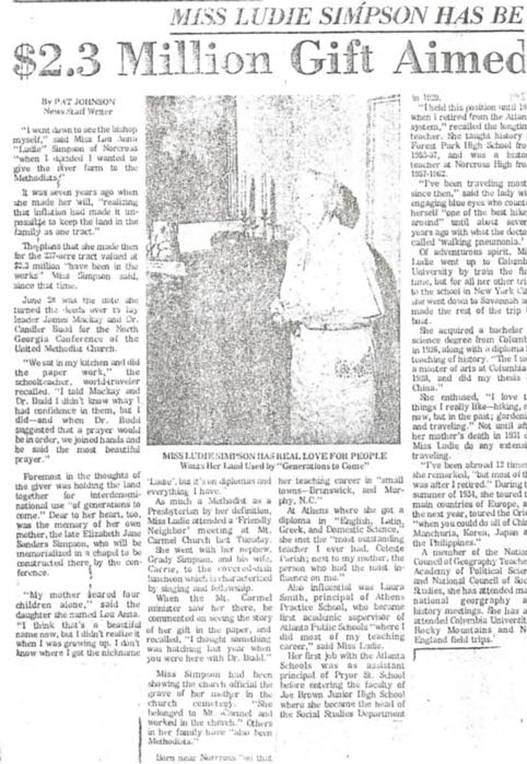
handsome buildings to teach and expand the horizons of its guests, so did Anna
Louise Simpson devote her life to teaching and inspiring her students.
With a bachelor's degree earned in 1910 from State Normal School, today's
University of Georgia, and later a master's from Columbia University, "Miss
Ludie" began a teaching career that spanned 35 years.
Her life
was something of a paradox. Living modestly in rooming houses near the
public schools in Atlanta and Gwinnett County where she taught, she relied
entirely on public transportation because she did not drive. Her hobby,
however, was travel - on a global scale. Miss Ludie's teaching was
enhanced by trips to China, England, and other international
destinations. She retired at the age of 70 and returned to the land of
her ancestors, living with her mother in Norcross. Family homestead land
around Norcross was never far from her memory even during her teaching
years. Weekend visits with her mother to the family farm on the
Chattahoochee River kept her ties with the ancestral land constant. Over
the years she bought from relatives, nearby family homestead acreage that had
been in the family for 120 years. Simpsonwood's Chapel stands near the
old family homesite.
In 1971,
at the age of 84, Miss Simpson decided to give the 239-acre farm, including a half
mile of river frontage, to the Presbyterian Church. A condition was
attached to the offer: Namely, always keep all of the land intact.
The Presbyterian Church balked at the condition, so Miss Simpson approached the
United Methodist Church, the church of her upbringing.
After
Bishop John O. Smith talked with Miss Simpson, he asked Dr. Candler Budd to
visit her and discuss the offer. Within 24 hours, Dr. Budd was in her
home, assuring her that the United Methodist Church wanted the property - on her
terms. Her vision was to keep the land intact so all people could enjoy
God's beauty. During frequent visits, Miss Simpson, Jamie Mackay,
Conference Lay Leader, and Dr. Budd walked the grounds together and focused on
seeing that vision implemented. Momentum for the new land, and for its
potential, grew rapidly. By 1973, the North Georgia Annual Conference
constituted a committee to study a conference center's feasibility.
Within the month, the 239-acre tract was deeded to the North Georgia Conference
of the United Methodist Church for the sum of one dollar. By the next
year, 1974, the conference went with Jamie Mackay's suggestion to form a
nonprofit corporation guided by ten, key, ex officio leaders and 20 others
elected by the conference.
Anna Louise
Simpson died April 29, 1975 without seeing Simpsonwood developed. She is
buried with her mother in the Mount Carmel United Methodist Church cemetery in
Norcross, Georgia. Amid the sadness of the funeral, an inspiration to
remember her generous gift came to John Wesley Pittman, a volunteer caretaker
of ht property, who had become close to Miss Simpson in her last years.
"Simpsonwood," a simple but elegant name, occurred to Pittman at her
funeral. Pittman always felt that Miss Simpson directed him to the
name. Jamie Mackay thought Pittman's inspirational name became official
with a conference resolution.
Much of
the 1970's found economic downturns slowing the center's development.
Pittman, however, found evidence during those years of Simpsonwood's earlier
inhabitants, like the stone fireplace from 1936 and Native American artifacts.
Under
the direction of contractor Kelly S. Barge Construction, Inc., the ambitious
project included two 32-room lodges and a conference center. The
conference center included: a kitchen and dining room with the capacity
to feed 240 guests at one sitting, two 150-seat conference rooms, and small
meeting rooms for committee use. While work was underway for the center,
Mrs. Mary Watson, wife of The Reverend Ralph Watson, concentrated on its
furnishings with the help of interior decorator Mrs. Kathy Green.
Together they tackled the negotiations for implementing the interior
design. Near the center's construction work other crews put in the
swimming pool and tennis courts.
Consecration
ceremonies for the Rollins Center were held on September 21, 1985.
Simpsonwood's growth continued. The first lodge, the McDavid Lodge, was
named for Bishop Joel McDavid, who led the fund-raising campaign for
Simpsonwood's construction, along with laymen Dan Pattillo and James Paine.
Another
of Miss Simpson's covenants for her Simpsonwood gift was for the church to
build an English style field chapel near her family's old homesite, with
construction costs not to exceed $300,000. The chapel is named for her
mother, Elizabeth Jane Sanders Simpson, while the chapel's stained glass window
is dedicated to her grandparents, Thomas McGregory and Mariah Jackson
Sanders. Design, construction, and funding for the chapel came from the
Knox Family of Thomson, Georgia in 1985. Those gifts were from Mr. and
Mrs. Peter E. Knox. Bishop Ernest Fitzgerald dedicated the chapel on.
A second
Simpsonwood lodge was built in 1986 thanks to the contribution of Mrs. Blanche
Hagan. She requested that the new Hagan Lodge be dedicated in memory of
her late husband, Mr. Harold Hagan. In 1987, the striking Christ doors
and glass panels were installed at the entrance to the Rollins Center, a gift
from Lucille and Arnold Hughey. The McDavid Lodge received a nice touch
in 1988, when the gathering room was dedicated to Daniel B. Pattillo, who was
honored as the first Simpsonwood Board of Directors Chairman from
1983-1986. A major addition to the Rollins Center was the basement level in 1989, another generous gift
of the Rollins family. The new basement was named the Budd-Mackay level
to honor the hard work of Jamie Mackay and Dr. Candler Budd in Simpsonwood's
early years. The new level was dedicated on September 21, 1989. Mary H.
Watson, who worked hard on the Rollins Center interior furnishings during its construction, was
honored when the Hagan Lodge's gathering room was named for her.
Furnishings for the room were given by Epworth United Methodist Church.
The consecration service was December 14, 1991.
Integral
parts of any conference center are maintenance and laundry. Those
services are centered today in the Herbert Mullenix Maintenance and Laundry Building,
built at a cost of $100,667 and consecrated the same day as the Watson Gathering
Room. This building honors Herbert Mullenix's leadership as Board
Chairman from 1989 to 1993.
The
Hickman-Post Lodge project began in 1992 with a one million-dollar donation
from Richard and Barbara Hickman, given in honor of their parents. The
Hickman-Post Lodge is part of the new D. W. and Ruth Brooks Complex, which
includes two lodges linked by central meeting rooms. Project architect
was Lowell Kirkman, a member of Dalton First United Methodist Church and second Chairman of Simpsonwood's Planning
Committee. Swofford Construction Company of Smyrna, Georgia was
the contractor. Groundbreaking for the Hickman-Post Lodge and Conference
Room began in April 1992, with the consecration by Bishop James Lloyd Knox on October 20,
1993.
THE DIRECTORS
The
first Director was The Reverend Jack Bozeman, who with the help of his wife
Jackie, worked tirelessly during 1984-87 to ensure the successful "startup" of
the Center. The Reverend Art O'Neil became Executive Director in 1987,
and developed new programs while expanding the existing ones. The
Reverend Marion Pierson became the Director in 1991.
The Caretakers
John Wesley Pittman 1975-1979
David Bradley 1979-1985
Cary and Lynn Buckley 1985
The Simpsonwood Auxiliary
Composed of some 80 men and women from 20 churches, they handle much of the "behind the
scene" work, and manage the Gift Shop. These dedicated volunteers, under
the leadership of Mrs. Ellen Van Cantfort, have been active since the beginning.
NOTES AND ITEMS OF INTEREST
The two original lodges, McDavid
and Hagan, are comprised of a mix of Tennessee field stone and cut-face
block. Each has 32 bedrooms, including two to accommodate the
handicapped, and one gathering room for conferences or fellowship.
The Rollins Center contains two
conference rooms on the main floor with capacities of 150 persons each that can
be combined to accommodate 350 guests, plus five smaller conference rooms on
the lower level. Kitchen facilities were designed to handle up to 700 at
a meal, but he dining room seats 240 at a time.
The chimney standing near the Chapel is
thought to be of American Indian construction because of the width (settlers
used narrow ones) and the use of mud as a bonding agent.
The carriage house used by the family still stands, somewhat behind the old chimney.
The corncrib, smokehouse, and potato barn date to the time of the family home.
More information can be found at:
http://www.simpsonwood.org/


