Chorus:
O, cruel was the snow that sweeps Glencoe
And covers the grave o' Donald
O, cruel was the foe that raped Glencoe
And murdered the house of MacDonald
They came in a blizzard, we offered them heat
A roof for their heads, dry shoes for their feet
We wined them and dined them, they ate of our meat
And they slept in the house of MacDonald.
Chorus:
They came from Fort William with murder in mind
The Campbell had orders King William had signed
"Put all to the sword" these words underlined
"And leave none alive called MacDonald"
Chorus:
They came in the night when the men were asleep
This band of Argyles, through snow soft and deep
Like murdering foxes amongst helpless sheep
They slaughtered the house of MacDonald
Chorus:
Some died in their beds at the hand of the foe
Some fled in the night and were lost in the snow
Some lived to accuse him who struck the first blow
But gone was the house of MacDonald
Chorus:
THE MASSACRE OF GLENCOE
FEBRUARY 13, 1692
In 1688, William of Orange convinced the English Parliament to oust the current King James VII of Scotland and of England and install
William himself as regent. At the time, England and Scotland was a boiling cauldron of national and religious animosities, not only
between the two countries but amongst political factions and the clans themselves.
An event in Scottish clan history was the appropriation of MacDonald property by the Campbells. The MacDonalds felt free to reclaim
cattle which they still considered their own. The Campbells called them reivers (raiders) and no love was lost between the two clans.
King William demanded an oath of loyalty by all clan chiefs with a deadline of January 1, 1692. MacDonald Clan Chief Alasdair Ruadh
MacIain, 12th Laird of Glencoe, known as Laird MacIain MacDonald, left this distasteful necessity to the last moment and made his way
to Fort William on December 31, 1691. Laird MacIain McDonald presented himself to Colonel Hill the governor, asking him to administer
the required oath of allegiance. Colonel Hill told the Laird that he must go to Inverarary, which wasn't easy in deep mid-winter snow
which covered the mountainous terrain, so he was late. This appears to have been a premeditated plot, involving secret letters, ignored
letters of free passage and other skullduggery by the current political officials. They gleefully planned to make an example of the
MacDonalds at Glencoe and the Campbells were not in the least reluctant to assist in the execution of this plan.
With instructions to kill every man of the MacDonald of Glencoe clan (approximately 200), Campbell of Glenlyon and some 128 soldiers,
of various clans, including the Campbells, called on Laird MacDonald, saying that they were in the area to collect taxes and asked for
his hospitality. For 12 days they had participated in a ceilidh,* ate the MacDonalds' winter food supply and drank to each other's health.
Exactly, according to plan, at five o'clock on the morning of February 13, 1692, Campbell of Glenlyon and his soldiers rose from their
beds to massacre their hosts. They managed to kill many MacDonald men, women and children in their homes, but some escaped only to be sent
naked, into a sudden blizzard, from their razed and looted homes. Thus, many more MacDonalds died from exposure. Very few MacDonalds
lived to tell the tale of this horrific tragedy.
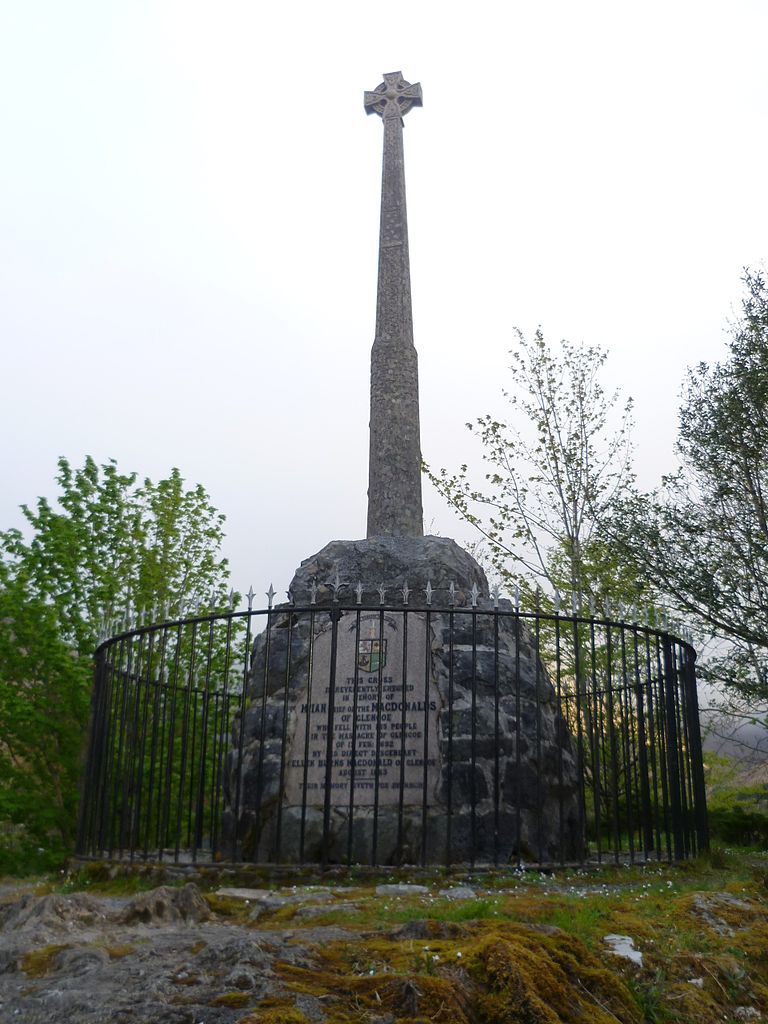
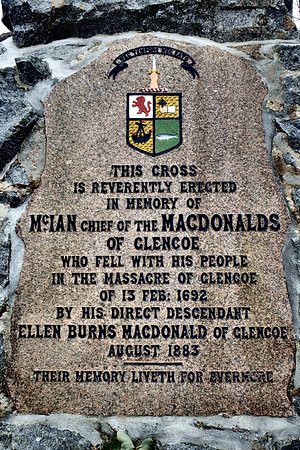
A monument to the fallen MacDonalds is situated in the Glencoe village. Laird MacIain MacDonald (b.1650 - d.1692, killed in the massacre) was
buried on the island of Eilean Munde, in Loch Leven, near the entrance to the Glen.
* Ceilidh – pronounced kay-lee – A Scottish social event of merriment where there’s music, singing and dancing.
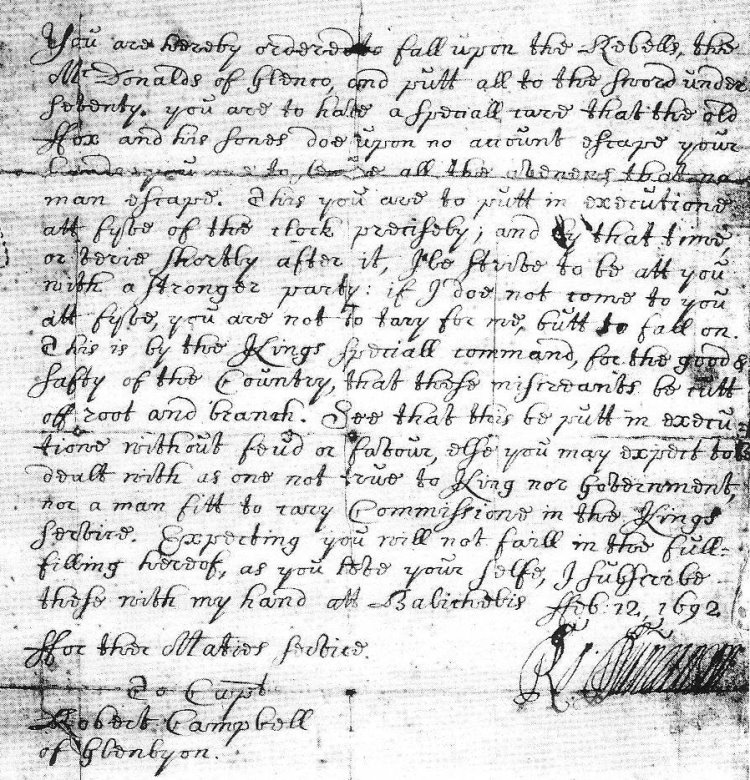
Order for Glencoe Massacre
Sent to Capt. Campbell by Maj. Duncanson
Transcription of Order for Gencoe Massacre:
You are hereby ordered to fall upon the rebells, the McDonalds of Glenco, and put all to the sword under seventy. you are to have
a speciall care that the old Fox and his sones doe upon no account escape your hands, you are to secure all the avenues that no man
escape. This you are to putt in execution att fyve of the clock precisely; and by that time, or very shortly after it, I’ll strive
to be att you with a stronger party: if I doe not come to you att fyve, you are not to tarry for me, but to fall on. This is by the
Kings speciall command, for the good & safety of the Country, that these miscreants be cutt off root and branch. See that this be
putt in execution without feud or favour, else you may expect to be dealt with as one not true to King nor Government, nor a man
fitt to carry Commissione in the Kings service. Expecting you will not faill in the full-filling hereof, as you love your selfe,
I subscribe these with my hand att Balicholis Feb: 12, 1692.