Ephraim McDowell
Courtesy of McDowell House Museum, Inc.
Copyright 2002-2005 McDowell House Museum, Inc. All rights reserved.

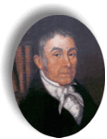
 phraim McDowell was
born in Rockbridge County, Virginia on November 11, 1771, the ninth of eleven children. He
came to Kentucky as a boy of twelve when his father, Samuel, was asked to serve as one of the
original judges for the land court. His father was a
veteran of the French and Indian War as well as a colonel during the American
Revolution. After the family moved to Kentucky, the senior
McDowell participated in the drafting of the Kentucky Constitution. Ephraim probably suffered
hardships in these early years on the frontier, as did every one moving into
this new land. Historians think that the challenges he met at this time
prepared him to think independently and act quickly later in his medical
career.
phraim McDowell was
born in Rockbridge County, Virginia on November 11, 1771, the ninth of eleven children. He
came to Kentucky as a boy of twelve when his father, Samuel, was asked to serve as one of the
original judges for the land court. His father was a
veteran of the French and Indian War as well as a colonel during the American
Revolution. After the family moved to Kentucky, the senior
McDowell participated in the drafting of the Kentucky Constitution. Ephraim probably suffered
hardships in these early years on the frontier, as did every one moving into
this new land. Historians think that the challenges he met at this time
prepared him to think independently and act quickly later in his medical
career.
Little is
known about Ephraim's education in Kentucky. In 1791 he went to Staunton, Virginia
to begin an apprenticeship to Dr. Alexander Humphreys. From there he
traveled to the University of Edinburgh, Scotland, the seat of medical learning
at the time. After 2 years in Scotland, he returned to open his practice
of medicine in Danville in 1795. In 1797 he purchased the apothecary
shop.
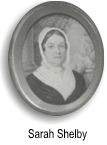
 n 1802, Ephraim married
Sarah Shelby, daughter of Isaac Shelby, the first governor of Kentucky. They
purchased a house adjacent to his shop. The McDowells had nine children
in this house, with five living to adulthood.
n 1802, Ephraim married
Sarah Shelby, daughter of Isaac Shelby, the first governor of Kentucky. They
purchased a house adjacent to his shop. The McDowells had nine children
in this house, with five living to adulthood.

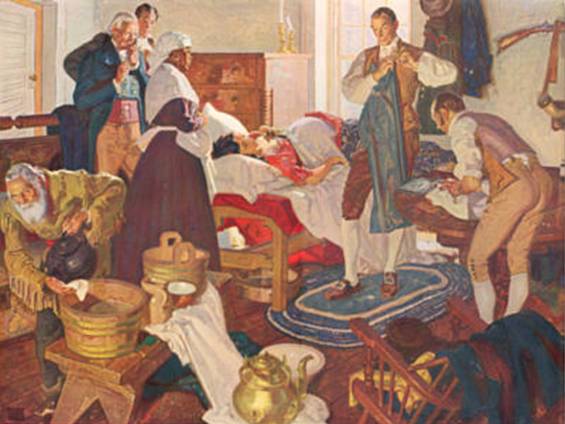
"The Dawn of Abdominal Surgery"
by Dean Cormell, N.A.
Commissioned by Wyeth Laboratories, Philadelphia
In 1809,
Dr. McDowell was called to Green County, Kentucky, to see a patient, Mrs. Jane
Crawford. Mrs. Crawford thought she was expecting twins. Upon
examination, Dr. McDowell realized she had an ovarian tumor. After consultation
with Mrs. Crawford, Dr. McDowell told her if she would travel to his home in Danville,
he would perform the experimental surgery. Dr. McDowell returned home. Mrs.
Crawford followed a few days later, sixty miles on horseback. She rested
several days after her arrival.
Then on
Christmas morning, 1809, Dr. McDowell began his historic operation. The
ovarian tumor he removed from Mrs. Crawford weighed twenty-two and one-half
pounds. The surgery was performed without benefit of anesthetic or antisepsis,
neither of which was known to the medical profession at the time. The
whole procedure took 25 minutes. Mrs.
Crawford's surgery was successful. She returned to her home in Green
County twenty-five days after the operation and lived another thirty-two years.
This was the first successful removal of an ovarian tumor in the world.
McDowell did
not immediately publish the results of this procedure. He was not a
prolific writer and waited until he had performed two further operations in
1813 and 1814 before publishing a report in 1817. This was widely
criticized in the English surgical literature. There is evidence that he
performed at least twelve operations for ovarian pathology.
"Having
never seen so large a substance extracted, nor heard of an attempt, or success
attending any operation such as this required, I gave to the unhappy
woman…information of her dangerous situation…. The
tumor…appeared full in view, but was so large we could not take it away
entire…. We took out fifteen pounds of a dirty, gelatinous looking
substance. After which we cut through the fallopian tube, and extracted
the sac, which weighed seven pounds and one half…. In five days I visited
her, and much to my astonishment found her making up her bed."
McDowell E., Three cases of extirpation of
diseased ovaria. Eclectic Repertory Anal Rev. 1817; 7:242-4.
One of Ephraim’s most famous
patients was James K. Polk, for whom he removed a gall stone and repaired a
hernia. He was a member of the Philadelphia Medical Society in 1817 and a
founder of Centre College in Danville, Kentucky, in 1819. He was also
well known for his generosity, and he performed considerable work for charity.
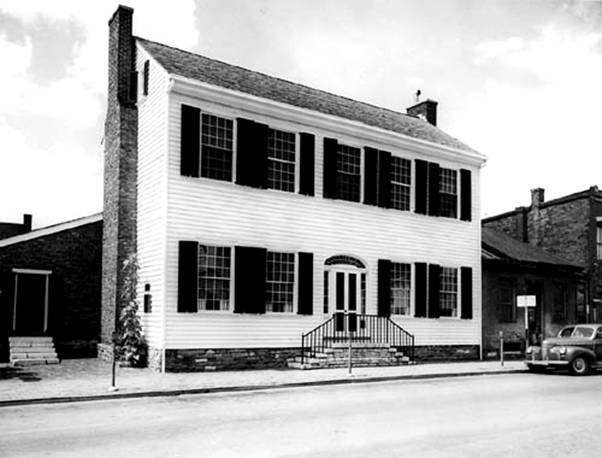
The McDowell House and Apothecary
Shop, as it appeared about 30 years ago. It was at this Danville, Boyle County,
location that Dr. Ephraim McDowell (1771-1830) first performed his
world-famous operation in 1809. The home, built on land owned by
Isaac Shelby, Kentucky's first governor and McDowell's father-in-law, has been
restored and is open to the public.
Dr.
McDowell continued his medical practice until his death from cramp colic in
June 1830, at the age of fifty-eight. Ironically, 21 years after his
historic surgery, the man who conquered abdominal surgery died of a
ruptured appendix. And Jane Todd Crawford, his famous patient, outlived
him and died at the ripe old age of 78.
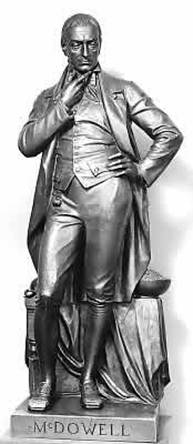
Bronze by
Charles H. Niehaus, given in 1929.
Location: Senate connecting corridor, 2nd floor
In 1879 a monument was erected in his honor in
Danville. In 1929, the state of Kentucky donated a bronze statue of McDowell to the U.S. Capitol
National Statuary Hall Collection. Dr. McDowell was the great great grandfather of General John
Campbell Greenway, whose statue was placed in the National Statuary
Hall Collection by the state of Arizona in 1930.
